

Barndominium Insulation Done Right

Ventilation considerations:
Unique Insulation Challenges:
Because barndominiums are built on a metal frame, ventilation has to be planned alongside the insulation, not as an afterthought. Moisture trapped between the metal skin and the insulation layer can lead to condensation, rust, and mold if there isn't a place for it to escape. Getting the vapor barrier and airflow right up front avoids problems that are much harder to fix once interior finishes are in.
Barndominiums are framed and built differently than a traditional stick-built home, and that changes how they need to be insulated. A metal shell holds heat and moves moisture differently than a wood-framed exterior, so getting the insulation approach wrong can mean a barndominium that's uncomfortable in summer, prone to condensation, and expensive to run.
Suggested insulation types:
Why proper insulation matters:
Spray foam for the roof and exterior walls: closed-cell spray foam adheres directly to the metal, seals every seam and fastener penetration, and acts as its own vapor barrier.
Batt insulation for interior walls: once the shell is sealed and conditioned, interior partitions typically use batt insulation for sound control and comfort between rooms.
A well-insulated barndominium holds a consistent indoor temperature instead of swinging with the outside weather, resists condensation forming inside the metal walls and roof, and keeps energy costs manageable despite the larger open floor plans barndominiums are known for.
Building or finishing out a barndominium?
Get a free quote
New Home Construction Insulation, Scaled to the Job
We partner with builders across Central Texas to provide professional blow-in insulation services that keep new construction projects on schedule. Our teams are equipped to handle large-scale residential developments and custom high-performance homes with the same precision and speed.
Blow-in fiberglass and cellulose insulation provide superior thermal coverage by filling every gap in the wall cavities and attics. By using high-efficiency application methods, we ensure a tight thermal envelope that meets modern energy codes and sets the standard for long-term comfort.
Building a new home? Let's talk about your timeline:


Attic Cleanouts & Retrofit Insulation
A lot of Central Texas homes are working with attic insulation that's decades old, settled, contaminated, or all three. Retrofitting starts with getting the old material out completely, not just adding new insulation on top of a problem.

What a full attic cleanout involves: Old insulation gets vacuumed out of the attic, clearing the space down to bare joists so the new insulation goes in clean, at full depth, and without whatever was mixed into the old material.
Why a full cleanout matters, not just a top-up: Old attic insulation often hides more than lost R-value. Rodent droppings, urine, and even dead animals accumulate in attic insulation over the years, and none of that goes away by covering it up. Airborne contaminants from rodent waste are a genuine health hazard, particularly for anyone with respiratory sensitivities, and a full cleanout removes that risk instead of insulating over it.
The benefit of retrofitting properly: A complete cleanout followed by fresh insulation at the right depth gives you an attic that performs like new construction, no hidden hazards, consistent coverage, insulation that's actually doing its job again.

Think your attic needs a cleanout? Get a free assessment:
Insulation for Ag Barns & Shop Buildings
Metal ag barns and shop buildings in Central Texas deal with some of the widest temperature swings of any structure on the property, and that swing is hard on the building, on equipment, and on anyone working inside.

Closed-cell spray foam on barn roofs: Closed-cell spray foam applied directly to the underside of a metal barn roof seals out radiant heat gain and adheres tightly to the metal, holding up under the kind of temperature stress ag and shop buildings see year-round.
Managing temperature swings on metal buildings: An uninsulated metal building can swing as much as 30 degrees between day and night temperatures, hard on stored equipment, feed, livestock housed nearby, and anyone spending real time inside. Proper insulation flattens that swing significantly.

Protect your barn or shop from Texas temperature swings:
Water Softener & Well House Insulation
A well house or water softener enclosure is easy to overlook until a hard freeze bursts a pipe. Central Texas seems to get one extreme cold event every year lately, and when it hits, unprotected well housing is exactly where pipes fail.
Preventing frozen and burst pipes: Insulating well housing and water-softener enclosures keeps the space around exposed pipes and equipment above freezing during cold snaps, protecting against burst pipes and the water damage and repair costs that come with them.
Closed-cell spray foam does double duty here. Beyond insulating, it seals up the gaps and openings that rodents and other pests use to get into well housing.
Protect your well house before the next freeze:

Storage Shed Insulation
An uninsulated storage shed in Central Texas turns into an oven by mid-afternoon in summer, hard on anything stored inside that's sensitive to heat, and an open invitation for pests looking for a way in.
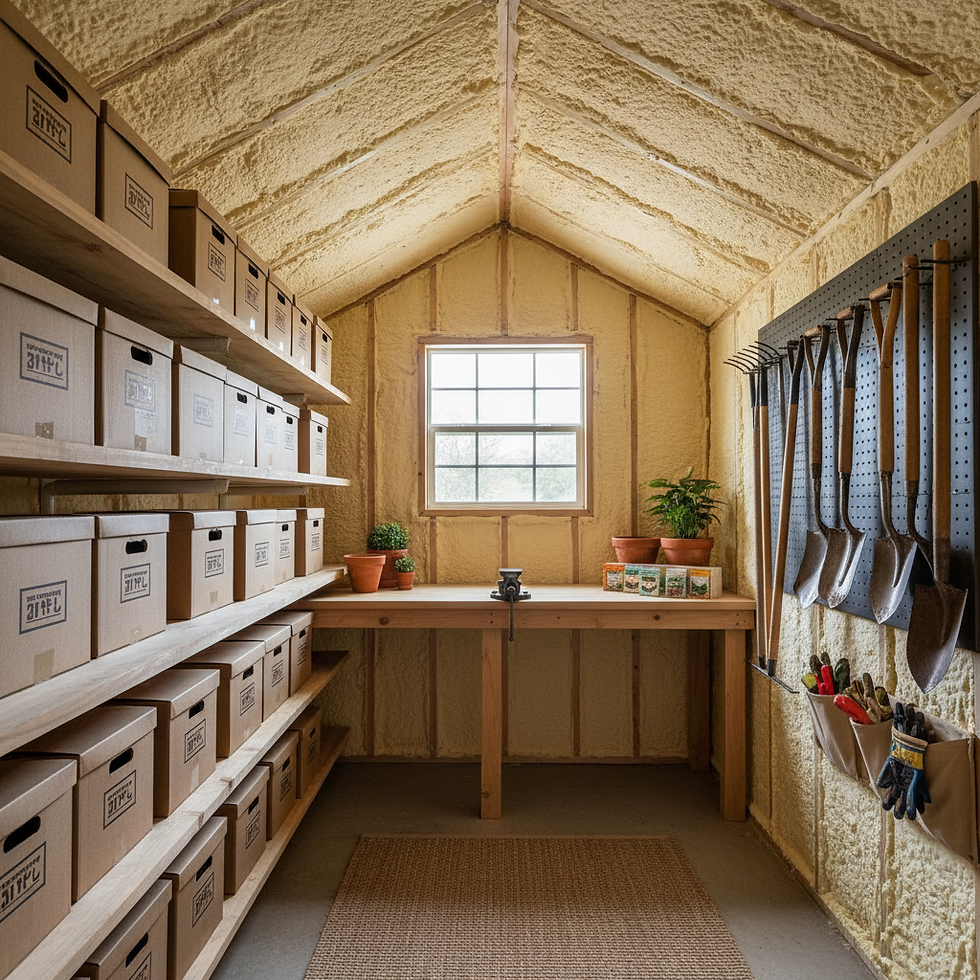
Keeping sheds cool:
Insulating a storage shed keeps the interior noticeably cooler through the hottest part of the day, protecting stored items and making the space usable for more than just overflow storage.
Keeping pests out:
Closed Cell Insulation also seals up the small gaps and entry points pests use to get inside.